Showing posts with label Class VII Science. Show all posts

Tuesday, 8 December 2020

RESPIRATION IN ORGANISMS Class 7 Chapter 10

 Key Learning Points- Respiration, Breathing, Breathing rate, Inhalation, Exhalation, Respiratory system, Cellular(Internal) Respiration, Aerobic respiration, Anaerobic Respiration, Transpiration, Gills, Spiracles, Trachea(Wind Pipe)

Introduction- We need energy to do every kind of work. This energy is obtained from oxidation i.e. burning of digested food in presence of oxygen inside the cells. In oxidation of food oxygen is taken, carbon dioxide gas is released and biological energy A.T. P.s (Adenosine triphosphate) are generated.

The process by which the digested and absorbed food (glucose) is oxidized to release the energy is called respiration.

Respiration occurs in two phases-

1. Breathing/ External respiration

2. Cellular/ Internal Respiration

1. Breathing / External respiration- The taking of oxygen rich air inside the lungs is called inhalation. The releasing of carbon-dioxide rich fowl air from the lungs is called exhalation. Breathing comprises both inhalation and exhalation.

Breathing Rate- The number of inhalation and exhalation per minute by a person is called breathing rate. In infants and children, the breathing rate is higher than an old person. During sleeping the breathing rate is less than the breathing rate during any activity like playing.

The average breathing rate in an adult person is 15-18 times.

2. Cellular/ Internal Respiration- The glucose is raw material for oxidation inside the cell. Here the enzymes and oxygen helps in synthesis of biological energy A.T.Ps. It is done in the mitochondria of cells. So, mitochondria are called ‘power house of the cell.’

BREATHING

RESPIRATION

It is a physical process.

It is a biochemical process.

It occurs outside the cells.

It occurs inside the cells.

Inhalation and exhalation occurs.

Oxidation of digested food occurs.

No energy is released.

Energy (A.T.P.) is released.

Types of cellular Respiration- There are two types of cellular respiration-

(a) Aerobic Respiration- The respiration that takes place inside the cells in presence of oxygen is called as aerobic respiration. The glucose is broken into carbon dioxide gas, water and ATPs.

Glucose + Oxygen -----> Carbon dioxide + Water + 36 A.T.Ps

(b)Anaerobic Respiration- The respiration that takes place in absence or partial presence is called as anaerobic respiration. On this basis there are two types of anaerobic respiration-

(b.1) Anaerobic Respiration in absence of oxygen/Fermentation-- The yeast cells in absence of oxygen prepare ethyl alcohol, carbon dioxide and little amount of A.T.Ps. Due to formation of carbon dioxide gas yeast is used in bakery to make bread.

Glucose ---Absence of Oxygen -----> Ethyl alcohol (or Ethanol) + Carbon dioxide + 2 A.T.Ps

This type of reaction is also called as fermentation. The alcohol production is called brewing. It is a very old method of wine preparation.


(b.2) Anaerobic Respiration in partial presence of oxygen-When muscles are working very actively and supply of oxygen upto the fatigue muscles becomes limited then anaerobic respiration occurs. As a result the lactic acid is formed in fatigue painful muscles cramps are caused.

Glucose ---Partial presence of Oxygen -----> Lactic Acid + 2 A.T.Ps

AEROBIC 

RESPIRATION

ANAEROBIC RESPIREATION

Occurs in presence of oxygen

Occurs in absence or partial presence of oxygen

Carbon dioxide gas and water are produced.

Ethyl alcohol, carbon dioxide gas or lactic acid are produced

36 A.T.Ps are released from one glucose.

2 A.T.Ps are released from one glucose.

Takes place all the time in living organisms.

Takes place for a short duration on living organisms.

Human Respiratory System – It consist of nose having nostrils, pharynx- common  passage for food and air and having muscular flap called epiglottis, trachea having larynx /Adam’s apple, bronchi, bronchioles and alveoli.


Mechanism of Respiration- The mechanism of respiration consists of inhalation and exhalation of air. During inhalation, the volume of chest cavity increases due to downward movement of diaphragm and upward and outward movement of ribs. The air pressure inside the chest gets reduced than the outside atmosphere. So, the oxygen rich air is inhaled.


During exhalation, the volume of chest cavity decreases due to back movement of diaphragm and ribs.

The air pressure inside the chest cavity is increased than the outer atmosphere as a result the carbon dioxide rich fowl air comes out.

Respiratory Gases percentage

          Breathing form

Gas Percentage

Inhalation

Exhalation

% of Oxygen

20.14 %

16.3 %

% of Carbon Dioxide

0.04 %

4.4%


Activity- To prove that CO2 Gas is released during exhalation-

Requirements- Lime Water (Calcium hydroxide), blowing glass/steel pipe, dropper and test tube

Procedure- In a test tube, lime water was gently taken with the help of a dropper. The air to be breath out is passed to lime water by blowing pipe. It was repeated about 10-15 times.

Result- The light blue coloured lime water turned into milky white colour. It is due to formation of calcium carbonate.

Lime water + Carbon dioxide (from exhalation) ----> Calcium carbonate (milky white)

Ca(OH)2 + CO2 ---> CaCO3 


Respiration in other organisms-

1. Insects- The insects have tracheal system as their respiratory system. The air is inhaled and exhaled through small pores ‘spiracles’ present on the side of their body.


2. Earthworm- The exchange of respiratory gases like oxygen and carbon dioxide occurs through thin and moist skin by diffusion. It is an example of cutaneous respiration.


3. Fish- Many of the bony fishes have ‘Gills’. The gills help in taking of oxygen dissolved in water and carbon dioxide is released through mouth.


4. Plants- The leaves have minute pores called ‘stomata’. Through stomata exchange of oxygen and carbon dioxide gas takes place. In the roots the exchange of gases occurs through the root has and outer epidermal cells by diffusion.


EXERCISE QUESTIONS-

Q.1 Why does an athlete breathe faster and deeper than usual after finishing the race?

Ans-


Thursday, 19 November 2020

SOIL Class 7 Chapter 9


                                                        SOIL Class 7 Chapter 9

LEARNING OBJECTIVES-

-Knowledge about soil and soil formation

- Soil Profile

-Types of soil

-Properties of soil

-Moisture content in the soil

-Absorption of water by soil

-Soil and Crops

Soil erosion and soil conservation-

SOIL-

The natural covering of broken rock particles and humus of the surface of the earth that supports life is called soil. Soil is the outer layer of the earth crust.


Soil supports plants and animals. The sources of food are grown in soil. Fuels, fodder, medicines and fibres are grown in soil. Water for drinking is mainly obtained as underground water. Soil is a habitat for many living organisms like, earthworm, ants, bacteria, fungi, wound worms etc. various kinds of minerals are obtained from the soil like gold, copper, manganese etc.

FORMATION OF SOIL-Soil is a mixture of sand, small rock particles and humus. The sand and small rock particles are formed by physical, chemical and biological weathering of rocks. The humus is formed by humification of dead organic matters. The process of soil formation is called pedogenesis. The study of soil and its properties is called pedology.

Pedogenesis = Weathering of Rocks + Humification

The wind, water, ice, temperature etc help in breaking of rocks. It is physical weathering of rocks. The water, organic acid like carbonic acid formed by decomposition of organic matter, chemical reactions in rocks and acid rain causes the weathering of rock by chemical methods. The animals and roots of plants are the biological agents for causing weathering of rocks.

SOIL PROFILE-

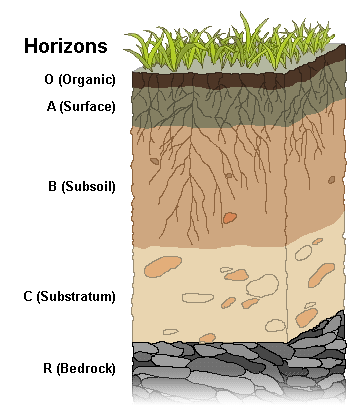
The vertical section of soil which shows differently coloured and textured layers is called soil profile. The chemical composition and depth of different layers of a soil profile also differ from each other. The layers of soil profile are as following-

1. A-Horizon or top soil layer - It is the upper most layer of the soil. It is dark in colour than other layers due to presence of humus (decomposed organic matter). It is soft and porous. It allows water to move inside the soil (water percolation) easily. It is rich in minerals, so plants grow easily. The water holding capacity of this layer is also more due to presence of humus. In this layer various kinds of insects, worms and roots of plants are found in this layer. 

2. B-Horizon or Subsoil layer – It is just below the A-horizon. It has very less amount of humus. It is less fertile than A-horizon. It has very less population of microorganisms. It is rich in minerals, harder and compact than top layer. It is slightly light in colour because of more minerals and less humus.

3. C- Horizon – It is just below the B-horizon. It has small rocks formed due to weathering of bedrocks. The roots of trees do not rich to this layer. Very little humus may be found somewhere in it.

4. R-Horizon or Bedrock or Parent rock- The bedrock undergoes weathering to add rocks, sand and minerals to the soil layers. It is very hard and does not allow the water to move down it.     


                               Fig: Soil Profile

TYPES OF SOIL-The size of rock particles are different in different soils. The colour of soil varies according to the presence of minerals and their characteristics. The chemical nature of soil classifies the soil also.

A. SOIL TYPES ON THE BASIS OF PARTICLE SIZE-

Following types of particles are found in the soil.

S.N.

Soil Particle

Particle size

1

Clay

Less than 0.2 mm

2

Silt

More than 0.2 mm

3

Sand

0.2 – 2.0 mm

4

Gravel

2.0 – 50 mm

So, soil types are-

1. Sandy soil- The soil which is mainly made up of large sand particles is called sandy soil. Clay and silt may be found very less in such a soil. It is mainly the desert area soil like Thar desert, Rajsthan, Haryana, Gujrat and Punjab. The soil is well aerated due to presence of quite large air-spaces in between soil particles. It has fewer nutrients. Its water holding capacity is less. It can be ploughed easily. It dries easily.


2. Clayey Soil- This soil has very small size clay particles. It smooth and its water holding capacity is very good. The aeration of this soil is not so good. The mineral nutrients are good in this soil. The ploughing of clayey soil is difficult. Sometimes water logging is seen in this soil.

3. Loamy soil- It is one of the best quality of soil for agriculture. It is made up of sand(40%), silt (40%) and Clay (20%). Its water holding capacity is good. It' minerals content is also optimum. It is suitable for all types of crops but wheat, pulses are mainly grown in this soil. 

B. SOIL TYPES ON THE BASIS OF PLACE OF FORMATION

1. Red soil

2. Black Soil

3. Alluvial Soil

4. Laterite soil

5. Mountain Soil

6. Desert Soil

C.SOIL TYPES ON THE BASIS OF CHEMICAL NATURE

1. Acidic soil- pH= 0-7

2. Basic (Alkaline Soil) - pH= 7-14

3. Neutral Soil – pH=0

Properties of Soil-

1. Colour of Soil- The colour of soil is due to mineral contents and organic matters present in it. Red, brown and yellow colours are due to different types of iron oxides in the soil. The black soil is due to certain other minerals, mountain lava and humus present in it.

2. Soil Structure- The soil texture/ structure is different for different kind of soil. Many soils are sticky while others do not stick with each other.

3. Percolation rate- The movement of water down the soil layers is called as percolation or seepage. It helps in recharging the underground water. Sandy soil has more water percolation rate while clayey soil has least water percolation rate.

     Percolation rate =Volume of water (in ml.)/Percolation time (in minute)

4. Absorption of water by soil- The water holding / absorption capacity of the soil is different for different soil. It is estimated by the formula as-

     Percentage Absorption of water by soil = Volume of water absorbed by the soil/    X 100

                                                                                                                                 Weight of soil

5. Moisture content in the soil- The little amount of water adhered to the soil particles is called soil moisture. In summer season, the dry soil has negligible moisture. In rainy season, the soil moisture will be high. When a little amount of soil is warmed in a test-tube, little water vapour can be seen on inner wall of beaker.

Activity 1- To find out the Percolation Rate of soil

Requirements- Clan ground of soil, hollow glass pipe, measuring cylinder, 250 ml water and a Stopwatch.

Procedure-Clean the ground and dig a small hole. Place a glass pipe in that hole and fill it up with soil. Now pour 250 ml of water and start noting down the time take in percolation of water with the help of a stop watch.

Observation- Approximately in 25 minutes 250 ml of water percolated through the soil.

So, we can calculate the percolation rate by the following formula-

Percolation rate =Volume of water (in ml.)/Percolation time (in minute)

                             = 250 ml/25 minutes

                             =10 ml/min.

Repeat this activity with sandy and clayey soil also. The sandy soil will have more percolation rate and clayey soil will show comparatively less percolation rate.

Activity 2- To calculate water absorption/water holding capacity of the soil-

Requirements- 100 gm dry powered Soil, a funnel, measuring cylinder, dropper, filter paper, 100 ml water and calibrated conical flask.

Procedure- The filter paper was folded as like a cup and place in the funnel. This was then placed in the mouth of conical flask. The 100 ml water was very slowly poured with the help of dropper.

Observation- The water that came down in the conical flask was 45 ml. It means 55 ml water was absorbed by the dry soil. So, the water absorption capacity of soil was calculated by the formula-

Percentage Absorption of water by soil = Volume of water absorbed by the soil/Weight of soil X 100

                                                                    =55 ml/100 gm X 100

                                                                     =55 %

Repeat this activity with sandy and clayey soil also. The sandy soil will have less water holding capacity and clayey soil will show comparatively more water absorption capacity.

 Soil and Crops- The crop to be grown in a particular soil depends on the following factors-

a. The type of soil.  

b. The climate of that region.

c. The mineral and humus contents of the soil.

1. Sandy Soil- It has low water holding capacity. The humus content is also low. The crops that grow well are wheat and legumes like gram, pea, vegetables, chili etc. Coconut grows in sandy soil of coastal areas.

2. Clayey Soil- Its water holding capacity is maximum. It is well for growing paddy, sugarcane, jute etc.

3. Loamy Soil- Its moderate water holding capacity, optimum humus and minerals content make loamy soil good for almost all type of crops. Paddy, Wheat, Legumes, Vegetables, Cotton, etc. grow well in loamy soil.

Soil Erosion- The top soil is very fertile. The carrying away of fertile topsoil by river water, heavy rain, strong wind, animals etc. from one place to another is called soil erosion. The grasses and roots of trees bind the soil and prevent soil erosion. 

Impacts of Soil erosion-

A. Soil erosion causes flood.

B. Soil erosion results into famine.

C. Soil erosion causes landslide in hilly areas.

Causes of soil erosion-

1. Overgrazing

2. Deforestation

3. Excess ploughing of cop fields

Soil Conservation- The judicious and economic use of soil is called soil conservation. Soil conservation is done to make soil usable for coming generations. Following are the common methods of soil conservation-

1. Afforestation-Plantation of trees on large scale.

2. Contour/step farming in hilly areas.

3. Avoiding overgrazing and excess ploughing of fields.

4. Construction of dams and river embankments.

Soil Pollution- The adding of harmful toxic substances which make the soil unfit for use is called soil pollution. Chemicals like paints, chemical fertilizers, polythene, plastic, salts, radioactive wastes, oil, grease, dye, acids, industrial wastes etc are some harmful substances which harm the soil.

The soil quality, percolation rate, fertility and water holding capacity are affected due to it.

 EXERCISE QUESTIONS-

Q.1

Friday, 30 October 2020

REPRODUCTION IN PANTS Class 7 Chapter 12

 INTRODUCTION-

Living organisms have a limited lifespan. Unless they are not going to form new organism, they will finish. Their continuity of life will be lost. So, fertile organisms form new organism of same kind either by self or by the help of other individual of same species. The process of formation of similar types of organisms by existing organism is called reproduction.

    There are two types of reproductions-

     (a) Asexual Reproduction – New organism is formed by single parent. It is common in plants     

          and animals.

     (b) Sexual Reproduction- New organism is formed by two parents. It is common in plants     

          and animals.

A. ASEXUAL REPRODUCTION IN PLANTS - New organism is formed by a single parent. It occurs by following methods-

1. Vegetative Propagation- The vegetative parts of plant is used to grow the new organism. e. g.- Roots in case of Sweet Potato and Mint, Stem in case of Strawberry and Chrysanthemum, Modified stem in case of Potato tubers, Leaves in case of Bryophyllum and African violet is used to develop new organism.


Vegetative Propagation also occurs by artificial methods like- Cutting, Grafting, Layering and Tissue culture. It is very useful for fruit yielding plants.


2. Budding- Bud is an asexual reproductive structure. This is an outgrowth of mother body in which a nucleus is found. The bud grows to form the new organism. e.g. – Yeast (A Fungus)

3. Fragmentation- Fragments are small asexual reproductive structures formed by fragmentation of mother body. Each fragment grows into a new organism. e. g.- Spirogyra


4. Spore Formation- Spores are small asexual reproductive structures that germinate to form new organism. Spores are formed in large number. They float in air and on finding suitable surface for germination, they form new organisms. The germinating surface must contain organic matter and water. e. g.- Ferns (Pteridophytes) and Fungi like Rhizopus, Mucor, Penicillium, Agaricus (Mushroom) etc.


B. SEXUAL REPRODUCTION IN PLANTS-   The reproduction in which two parents, one male and one female are required to form the new organism is called as sexual reproduction.


Flower is the reproductive part of the plant. The complete flowers have all the four whorls but incomplete flowers have less than four parts. It has male part called stamen and female part called pistil (or carpel). Stamen forms pollen grains that contain male gametes. Carpel has ovary that contains eggs.

Uni-sexual and Bisexual Flowers- Those incomplete flowers which have either pistil or stamen are called uni-sexual flowers. e. g.-Papaya, Maize, Cucumber etc.


Those flowers which have both pistil as well as stamen are called as bisexual flowers. e. g.- Rose, china-rose, mustard, marigold, lotus etc.


Pollination- The transfer of pollen grains from anther to the stigma is called pollination. There are two types of pollinations-

A. Self fertilization

B. Cross fertilization

When transfers of pollen grains occur from anther to the stigma of same flower, it is called as self fertilization. When transfers of pollen grains occur from anther to the stigma of different flower, it is called as cross fertilization.


On stigma, pollen grains germinate to form pollen tube in which male gametes are found. The pollen tube moves below inside the ovary for fertilization.    

Fertilization- The fusion of male gamete with female gamete to form zygote is called fertilization. As a result of fertilization, single celled zygote is formed.

Formation of Fruits and Seeds- As a result of fertilization some post-fertilization changes starts. The ovary changes into fruit and ovules change into seeds. So, fruit is ripened ovary.

Seed- The seed develops from the fertilized ovules. They have an outer protective covering called seed coat. The Seed has either one cotyledon or two cotyledons. Cotyledons are nutritive cells that give food to developing radical and plumule.

Seed Germination- The seeds can remain in dormant stage for many months to many years. On finding suitable conditions, the seed germinate to form radicle and plumule. The small embryo develops into radicle and plumule. The root system develops from radicle and shoot system develops from plumule.

Seed Dispersal- The method of going of seed from one place to other by an agent is called seed dispersal. The agents to seed dispersal can be- air, wind, water, animals including humans, bats, explosion etc.

Some seeds have hairy structures and wings so they are carried away by wind to other place.