Wednesday, 6 May 2020

MICROORGANISMS: FRIEND OR FOE? Chapter 2 Class VIII


MICROORGANISMS: FRIEND OR FOE?    Chapter 2   Class VIII
Introduction- Those organisms which can only be seen by using microscope are called microorganisms or microbes. e. g-Bacteria, Viruses, Protozoa, Algae, etc. Microbes are useful to us as well as harmful. Many of them cause diseases in plants and animals. Many of the spoil the food, therefore, food preservation methods should be adopted. Many of microbes are useful and help in curd making, fixation of atmospheric nitrogen in the soil, medicine preparation, humus formation etc.  The study of microbes is called microbiology.
Distribution of microbes-The microbes are ubiquitous. They are found in air, pond water, hot spring water, ocean water, ice, soil, plants, spoiled food, old teared shoes, rock cracks, old books, etc. But, they are not found in healthy part of plants, inside healthy person’s body, inside active volcano and inside deep layers of the rock. A type of bacteria called Archebacteria can survive in hot spring water upto 78 degree Celcius temperature. Some bacteria can survive in extreme cold upto - 90 degree Celcius temperature. Let us now do details of these microorganisms –
1. Bacteria (Singular–Bacterium)- They are unicellular, prokaryotic, colourless microorganisms. On the basis of shape, there are four types of bacteria-a) Coccus or Spherical bacteria   b) Bacillus or Rod Shaped bacteria  c) Spirillum or Spiral bacteria and d) Vibrio or Comma shaped bacteria. Bacteria were discovered by Anton van Leeuwenhoek-a Dutch scientist from Netherland.
                                 Types of bacteria on the basis of shape
The bacteria cause a number of diseases in plants and animals. E.g. Cholera, Anthrax, Typhoid, Tetanus, Tuberculosis (CAT3), diarrhoea, Pneumonia, Whooping cough etc. They are useful also. They are found almost everywhere. Rhizobium bacteria are found in root nodules of leguminous plants and help in atmospheric nitrogen fixation. Lactobacillus bacteria convert milk into curd by fermentation. Escherichia coli are also friendly bacteria found in our large intestine. The branch of science which deals with the study of bacteria is called as bacteriology.
2.  Fungi- (Singular – Fungus) – They are non-green organisms that grow on any habitat that contains organic matters. They do not contain chlorophylls. They absorb the nutrients from organic matters. They grow on moist bread, leather, rotten vegetables and fruits, rotten logs, animal dung etc. They are microscopic as well as non-microscopic. They are unicellular as well as multi-cellular. e.g.-Yeast (Unicellular, Eukaryotic cell), Rhizopus (Black bread mould), Penicillium, Aspergillus, Agaricus compestris (Mushroom) etc.
     

 Examples Of Fungi


Many fungi cause diseases like skin diseases and spoil the food items. Some of the Mushroom varieties are edible. The branch of science which deals about the study of fungi is called mycology.
3.    Algae (Singular – Alga)-Algae are mainly aquatic plants that are found in water and moist surfaces. They are green, red and brown in colour. They are unicellular as well as multi-cellular. They are prokaryotic as well as eukaryotic organisms. The unicellular prokaryotic algae are called blue green algae or Cynobacteria.
Chlamydomonas have two flagella that help in swimming. Volvox is a movable colony. Some are as long as 80 feet. Some algae are edible. Iodine is obtained from brown algae. Nostoc and Anabena helps in nitrogen fixation. Spirogyra has filamentous multi-cellular body and has spiral chloroplast. The study of algae is called algology or phycology.

4. Protozoa (Singular-Protozoan)-They are unicellular, eukaryotic microscopic organisms. They are found in water and body of living organisms. They travel by some special structures of their body like- Cilia (hair like), Flagella (Whip like) or Pseudopodia i.e. false foot. e.g.- Amoeba, Paramecium, Entamoeba, Trypanosoma etc. Many of them cause diseases like Entamoeba histolytica causes amoebiasis due to drinking of contaminated water and Trypanosoma causes sleeping sickness. The study of protozoa is called protozoology. Protozoa are members of Protista Kingdom.  


5. Viruses (Singular- Virus) - Viruses are ultra microscopic, non-cellular and intensely infectious microorganisms. They are made up of genetic material (D.N.A. /R.N.A.) and Protein.  They have either D.N.A. or R.N.A but never both. They are non-living (dead) outside the body of living organisms but becomes alive, active and start multiplying in the body of living organisms. So, viruses are called connecting link between livings and non-livings. Viruses are like biological puzzle whether to be called living or nonliving. e.g.- Corona Virus, AIDS (Acquired Immune Deficiency Syndrome) Virus or HIV (Human Immunodeficiency Virus) , SARS Virus, Polio Virus, Tobacco mosaic Virus (First discovered virus by Dmitri Ivanovsky in Russia),  Influenza virus  etc.


Microorganisms and the Human Beings- Microorganisms are useful as well as harmful for the human beings. From ancient period useful microbes are used by humans to make, curd, wine, Idli, Dosa etc. Many microbes are harmful and cause diseases in humans.
Useful Activities of microbes-
1.     In making of curd and cheese- The curd is made from milk. The process of making curd is called curdling. Lactobacillus bacteria sour the milk and help in curd formation. Streptococcus bacteria are also found in curd. Cheese is also prepared by Lactobacillus bacteria.
               
2.   In making of bread- Yeasts are used to make bread from flour, and lukewarm water.  The dough of flour is prepared and yeasts are added. Yeasts do fermentation of sugar of dough to produce carbon dioxide gas and ethyl alcohol. The bubbles of carbon dioxide make the dough fluffy and spongy. After baking the dough the bread is prepared.
Fermentation- It is an anaerobic decomposition of carbohydrate (sugar) containing substance by yeasts to form carbon dioxide gas and ethyl alcohol. Fermentation is known to humans many centuries earlier but it was Louis Pasteur who discovered fermentation in 1857. Fermentation is used to prepare wine, beer and toddy like alcoholic beverages. It is used in making of bread, Idli and Dosa.  
3.   In making of Idli and Dosa- Idli and Dosa are prepared from the paste of black gram. This paste is kept overnight or for 8-10 hours for fermentation in air. Streptococcus bacteria help in this process. The carbon dioxide gas released in this process makes the paste fluffy and spongy. After steaming or baking the fermented paste, Idli and Dosa are prepared.  
4. In making of sausages- By fermenting chicken, pork like meat sausages are prepared. They last longer comparatively.
5.   In making of beverages- Ethyl alcohol is found in beverages like wine, beer, rice beer and toddy. Ethyl alcohol is formed due to fermentation of sugar containing substances by yeast. Fermentation is an anaerobic process i.e. no oxygen is required in it. Sugarcane, grapes, rice, molasses, other fruits are used to prepare wine. Barley is used to prepare beer. Toddy is prepared by fermenting toddy palm and coconut water.
6.   Agar Agar- Agar Agar is obtained from seaweeds i.e. marine algae. It is used as health supplement. It is used for growing of bacteria and fungi in laboratories. It is used in making of puddings, custards, sauces etc. 
                                      
7.  Spirulina – Spirulina is a biomass of Cynobacteria (earlier called as blue green algae). They are rich in protein; therefore, Spirulina is used as protein supplement by humans and some aquatic animals.
8.    Cleaning environment and humus formation- Humus is dark colored organic matter formed by decomposition of dead and decaying plant and animal debris. The humus is rich in nutrients and when mixed with soil, increase the water holding capacity, aeration, and improve soil texture. The bacteria and fungi decompose the dead plants and animals. They are called decomposers.
9.   Nitrogen Fixation and increasing soil fertility by some bacteria and blue green algae- Nitrogen is most essential soil nutrient for plants. Some bacteria like Rhizobium shows symbiotic association within root nodules of leguminous plants like pea, gram, mustard, Linseed, soybeans etc.  These bacteria help in fixing atmospheric nitrogen in the soil which is taken by plants. Blue green algae (Cynobacteria) like Anabena and Nostoc also fix atmospheric nitrogen in soil. Blue green algae work as biofertilizers.
10.  In making of Antibiotics- Antibiotics are medicines to cure bacterial infections and diseases. The first antibiotic ‘Penicillin’ was discovered by Alexander Fleming in 1929 at London. Penicillin was called ‘wonder drug’ because of curing T.B. (Tuberculosis) patients at that time. Antibiotics are prepared from bacteria and fungi. E.g. Penicillin, Tetracycline, Streptomycin, Erythromycin, Chloramphenicol, Aureomycin etc. Antibiotics are given to patient in form of tablet, capsule or injections.  
Precautions while taking antibiotics-
a.  Antibiotics should be taken only on the prescription of a qualified doctor.
b. The course of taking antibiotics must be completed as prescribed by the doctor.
c. When unnecessarily or wrongly taken the efficacy of antibiotics becomes less when needed next time.
d. They have side effects and kills beneficial bacteria of body if wrongly and unnecessarily taken.
11.   Vaccines- when a pathogen (disease causing microbe) enters inside the body, the body prepare antibodies to fight the pathogen. The pathogen is called antigen. If there is victory of antibodies over antigen, then body remembers how to fight against the same pathogen if it enters the body once again. The antibodies remain inside the body. This is how vaccines work.
In vaccine a low strength (usually heat killed) pathogen is administered orally of by injection in the body. So, the body becomes immunized by vaccination. If the same pathogen infects the body, there will be no disease. Vaccination causes immunization.
Edward Jenner (An English Doctor) discovered vaccine for smallpox disease in 1798.
Harmful activities of microbes- Many microorganisms are harmful to humans, animals and plants. The disease causing microbes are called pathogens. Microbes spoil the food, clothes and leather. Let us study in details-
1.   Disease causing microbes in humans- The pathogens enter in the human body through air, water, or food. Pathogens (germs) also enter the human body by contact of infected humans, animal, soil or any other source of infection. Those diseases which spread from an infected person to a healthy person by air, water, food or physical contact are called communicable diseases. e.g.- Cholera, Common cold, Chicken pox, tuberculosis etc. The modes of communication of diseases are different.
The animals and insects act as carrier of diseases. They help in spreading of diseases. Carriers of diseases are also called as vectors.
Example 1-Flies like house flies sit on garbage and animal excreta and pathogens present in that stick to their bodies. When houseflies sit on food items, the pathogens come to food. On eating such contaminated food the person becomes sick. We should avoid eating of uncovered foods.
Table 2.1  Some common Human Diseases caused by Microorganisms
HUMAN DISEASE
CAUSATIVE MICROORGANISM
MODE OF TRANSMISSION
GENERAL PREVENTIVE MEASURE
Cholera


Typhoid
Bacteria


Bacteria
Contaminated Water/ Food


Contaminated Water
Maintain personal hygiene and sanitary habits. Eat well cooked food and boiled drinking water. Vaccination
Tuberculosis
Chicken Pox

Measles

Polio
Bacteria

Virus


Virus

Virus
Air

Air/Physical contact


Air

Air/ Contaminated water
Complete isolation of patient, Keeping away of personal belongings of patients. Vaccination
Hepatitis
Virus
Contaminated water
Drinking boiled water. Vaccination
Malaria
Protozoa
Mosquito
use mosquito repellent, No water logging and spray Insecticide in surrounding

Example 2- Female Anopheles mosquito is the carrier of malaria parasite (Plasmodium vivex). Plasmodium vivex is a protozoan. When it bites the healthy person, the malaria parasite enters the body and causes malaria disease.
Example 3- Female Aedes mosquito is the vector of dengue virus.
  
2.  Disease causing microbes in animals- A number of diseases are caused by microbes in humans. e.g.- Anthrax is a bacterial disease caused in humans and cattle. Robert Koch (1876) discovered the Bacillus anthracis bacterium which causes anthrax disease.  Foot and mouth disease of cattle is caused due to a virus.
3.     Disease causing microbes in plants- The crop plants, cereals, pulses, vegetables, fruits are infected by plant pathogens. Due to this crop productivity reduces. Mainly bacteria, fungi and viruses cause diseases in plants. By using fungicides, insecticides, other chemicals and methods disease instances can be reduced and checked.
Plant Disease
Microbe
Mode of Transmission
Tobacco mosaic
Virus
Contact by body and clothes
Citrus canker
Bacteria
Air
Rust of wheat
Fungi
Air, Seed
Late blight of potato
Fungi
Air, Water


4.    Food poisoning- The uncovered and long time prepared food often get infected by microbes like bacteria and fungi. These microbes release toxic substances which make the food poisonous. On consumption of such foods the person becomes seriously ill and even death may be caused. So, the preservation of food to prevent it from being spoil is essential.
FOOD PRESERVATION METHODS- The unpreserved food is attacked by bacteria and fungi. The spoiled food has foul smell, colour change and change in taste. It is not safe to eat such soiled food. But, the pickles do not spoil easily because some preservatives are added in it. Let us discuss some of food preservation methods.
1.   Preservation by Chemicals – Those salts which are used to prevent growth of microbes in food items are called food preservatives. e.g. Sodium benzoate  and Sodium matabisulphite. They are added in pickles, jams, squashes and other canned foods. 
2.   Preservation by common edible salt – Salts control the growth of bacteria and fungi. Meat, fish, amla (richest source of vitamin C), raw mango, pickles, tamarind, etc. are used to preserve by salting.
3.    Preservation by sugar- Sugar helps in reducing the moisture content in the food. So, the growth of bacteria and fungi is inhibited and food does not spoil. E.g. Jams, Jellies and Squashes are commonly preserved by sugar. Murraba (made up of amla fruits) and sweets have huge amount of sugar to prevent their spoilage.
4.      Preservation by oil and Vinegar- Edible oils checks the contact of oxygen with air and makes the environment in such way that prevents growth of bacteria. 5 % acetic acid is called vinegar. Vinegar is used to prevent growth of bacteria and fungi. So, oils and vinegar are used to control spoilage of pickles, vegetables, fruits, fish and meat.
         
5.   Heat and cold treatment- Heating and boiling kills many microbes. The milk which is heated at 70 degree C temperature for 15 to 30 seconds and suddenly chilled and stored is called pasteurised milk. Such milk can be consumed even without boiling as it is free from germs. Pasteurisation was discovered by Louis Pasteur. In refrigerators the temperature is reduced. So, the bacteria and fungi becomes almost inactive and do not release enzymes for spoiling the food.
6.    Preservation by storing and packing- The air tight packets of food like dry fruits and vegetables prevent their spoilage. The nitrogen gas filled in chips packets also prevent its’ spoilage.  
                   
  
7.   Preservation by smoke and sun drying- Smoke and sun drying reduces the moisture content in the food. So, the food and seeds last longer. E.g. Fish, meat, mushroom, rice, are commonly preserved by these methods.
NITROGEN FIXATION- There are some free living soil bacteria and bacteria that form symbiotic association with roots of leguminous plants help in fixation of atmospheric nitrogen in the soil. Rhizobium bacteria is found in the root nodules if leguminous plants. They fix nitrogen and in turn get the food. That part of root nodules has a pigment called leghaemoglobin. Cynobacteria (blue green algae) like Nostoc, Anabena, etc. fix the atmospheric nitrogen in soil. They are called biofertilizers.


NITROGEN CYCLE- The percentage of nitrogen in the atmosphere is 78 %. Nitrogen is very essential for living organisms as it is a constituent of proteins, vitamins, Chlorophylls, nucleic acids like D.N.A and R.N.A. The atmospheric nitrogen cannot be taken directly by plants and animals. Certain bacteria and Cynobacteria (blue green algae) fix the atmospheric nitrogen in the soil in form of nitrogenous compounds. In factories when chemical fertilizers are prepared and also during lightening, nitrogen is fixed in nitrogenous compounds.
                       
The nitrogenous compound present in the soil is taken by plants along with water absorption. Nitrogen is then used to prepare vitamins, chlorophylls, nucleic acids and proteins. The nitrogen comes to animals when they eat them and their products. When plants and animals die, decomposers like bacteria and fungi release the nitrogenous compounds in the soil. Another kind of bacteria called denitrifying bacteria release the nitrogen from the nitrogenous compounds. Thus, the percentage of nitrogen remains almost constant in the atmosphere.
For more information visit the following websites- www.microorganisms.com
                                                                                  www.biology4kids.com

CHECK YOUR PROGRESS                     Time- 1: 15 Minute    Total Marks =32

Q.1 What are antibiotics? What precautions must be taken while taking antibiotics?-5
Q.2 What are carriers? Give two suitable examples of carriers and diseases carried by them.-5
Q.3 Name the organisms that fix atmospheric nitrogen.-2              
Q.4 Write a short note on usefulness of microbes.- 5
Q.5 Write a short note harms caused by microbes.-5
Q.6 Explain any five methods of food preservation.-5
Q.7 Explain the nitrogen cycle with a suitable diagram.-5


EXERCISE QUESTIONS –SOLVED
Q.1 Fill in the blanks.
(a) Microorganisms can be seen with the help of a …………………
(b) Blue green algae fix ………………….. directly from air to enhance fertility of soil.
(c) Alcohol is produced with the help of …………………….
(d) Cholera is caused by ……………………….
Answer- (a) microscope   (b) nitrogen   (c) yeast   (d) bacteria
Q.2 Tick the correct answer:
(a) Yeast is used in production of -
 (i) Sugar                                             (ii) Alcohol
(iii) Hydrochloric acid                        (iv) Yeast
(b) Which of the following is an antibiotic-?
(i) Sodium bicarbonate                        (ii) Streptomycin 
(iii) Alcohol                                         (iv) Yeast
(c) Carrier of malaria causing protozoan is-
(i) Female Anopheles mosquito          (ii) Cockroach
(iii) Housefly                                       (iv) Butterfly
(d) The most common carrier of communicable disease is-
(i) Ant                                                   (ii) Housefly
(iii) Dragonfly                                      (iv) Spider
(e) The bread or idli dough rises because of-
(i) heat                                                 (ii) grinding
(iii) growth of yeast cells                    (iv) kneading
(f) The process of conversion of sugar into alcohol is called –
(i) nitrogen fixation                           (ii) moulding
(iii) fermentation                               (iv) infection
Answers- (a) Alcohol       (b) streptomycin                (c) female Anopheles mosquito  
                  (d) housefly    (e) growth of yeast cells    (f) fermentation

Q.3 Match the organisms in Column A with their action in Column B.
             Column A                    Column B
(i)                  Bacteria                        (a) Fixing nitrogen
(ii)                Rhizobium                    (b) Setting of curd
(iii)               Lactobacillus                (c) Baking of bread
(iv)              Yeast                              (d) Causing malaria
(v)                A protozoan                   (e) Causing cholera
(vi)              A virus                           (f) causing AIDS
                                         (g) Producing antibodies
Answer- (i) –e        (ii) – a       (iii) – b    (iv) – c  (iv) – d  (v) – d    (vi) – f

Q.4 Can microorganisms be seen with naked eyes? If not, how can they be seen?
Ans- No, microorganisms cannot be seen with naked eyes. Microorganisms are so tiny that they cannot be seen by naked eyes. They can only be seen with the help of microscope.

Q.5 What are the major groups of microorganisms?
Ans- The microorganisms are broadly classified in to five major groups-Bacteria, Viruses, Algae, Fungi and Protozoa.

Q.6 Name the microorganism which can fix atmospheric nitrogen in the soil.
Ans- The Cynobacteria (Blue green algae), Rhizobium and some free living soil bacteria fix atmospheric nitrogen in the soil.

Q.7 Write 10 lines on the usefulness of microorganisms in our lives.
Ans- The usefulness of microorganisms are as following-
a.)    In making of curd and cheese the Lactobacillus bacteria are used.
b.)    In making of bread the yeast are used.
c.)     In making of Idli and Dosa yeast are used.
d.)    In making of sausages and fruit vinegar microbes are used.
e.)    Cleaning environment and humus formation occurs by bacteria and fungi.
f.)    Nitrogen Fixation and increasing soil fertility occurs by free living soil bacteria, Cynobacteria and Rhizobium bacteria.
g.)    In making of antibiotics some bacteria and fungi are used.
h.)  Vaccines are prepared from microbes. Vaccines contain antigen that develops immunity against diseases.
i.)  Spirulina is an alga which is rich source of protein. This is eaten as health supplement.
j.)    Agar Agar is obtained from marine algae. It is used as stabilizing and thickening agent for puddings, custard, sauces etc. Agar is also used as culture medium for growing bacteria, fungi in laboratories.
Q.8 Write a short paragraph on the harms caused by microorganisms.
Ans- Microbes are not only useful to plants, animals and humans but very harmful to these. Some microbes spoil food, clothes and leather. Microbes cause a number of diseases in plants, animals and humans.

Q.9 What are antibiotics? What precautions must be taken while taking antibiotics?
Ans- Antibiotics are medicines to cure bacterial infections and diseases. e.g. Cholera, Anthrax, Typhoid, Tetanus, Tuberculosis, Pneumonia, whooping cough etc.The following precautions should be taken while taking antibiotics-
a.   Antibiotics should be taken only on the prescription of a qualified doctor.
b.  The course of taking antibiotics must be completed as prescribed by the doctor.
c.  When unnecessarily or wrongly taken the efficacy of antibiotics becomes less when needed next time.
d. They have side effects and kills beneficial bacteria of body if wrongly and unnecessarily taken.
THANKS

Disclaimer- The contents written in this chapter are based on various sources. Any similarity will be considered as a coincidence.
Suggestions for further improvement are most welcomed.


Saturday, 18 April 2020

CROP PRODUCTION AND MANAGEMENT Chapter 1 Class 8 (C.B.S.E.)


 INTRODUCTION- Early people were nomadic. They wander from one place to another for food and shelter. They were depended on raw fruits, roots, vegetables, leaves and hunted animals as food. About 10000 B.C., they started to cultivate land by settling near the crop fields and produced Rice, wheat, and other food crops. Thus, they learnt domesticating animals like sheeps, dog, horse, cow, goat etc. and started agriculture.
 At present, India is second largest country in agricultural output. The total contribution of agriculture and related sectors in GDP of India is 15-16 % (approximately). To provide food to the vast population extensive and intensive agriculture practices are essential. Regular production, proper management and rational distribution are also necessary.
AGRICULTURE AND CROPS- The cultivation of land, growing crops, it’s processing and rearing of animals to get food, fibers and other products is called agriculture. Latin words -Ager (field) + culture (to grow) = Agriculture. When plants of the same kind are grown and cultivated at one place on a large scale, it is called a crop. e.g.- The crop of Paddy shows all the standing Paddy plants at a glance.   The crops can cereals, pulses, vegetables and fruits. Inspite of diversity in growing of crops, the crops on India can be broadly classified into two types-
   (a)    Rabi or winter crops
                (b)  Kharif or summer crops
(a)    Rabi or winter crops- The crops grown in the winter season are called Rabi or winter crops. They are sown during October-November months and harvested during March- April months. They need less water and sunlight duration. e.g.- Wheat, barley, pea, gram, mustard, linseed etc.
                   
Maize  Crop

(b)   Kharif or summer crops- The crops grown in summer season are called Kharif or summer crops. They are sown during June-July months and harvested during September-October months. In India, they are cultivated during rainy season mainly when Monsoon comes. They need more water and more sunlight duration. e. g-Paddy, Maize, Soybeans, Groundnut, Cotton etc.

S.N.
                       Rabi Crops
                      Kharif Crops
1
They are grown in the winter season.
They are grown in summer season.
2
They are sown during October-November months.
They are sown during June-July months.
3
They are harvested during March- April months.
They are harvested during September-October months.
4
They need less water.
They need more water.
5
They need less sunlight duration.
They require  more sunlight duration
Note- Different kinds of vegetables and fruits can be grown in between Rabi crop season and Kharif Crop seasons. They are called Zaid crops.
BASIC PRACTICES OF CROP PRODUCTION- Those activities which are performed in proper sequences to grow healthy crops are known as basic agricultural practices.  These are –
1.       Preparation of soil
2.       Seed sowing
3.       Replenishing soil by natural method and adding manures and fertilizers
4.       Irrigation
5.       Protection from weeds, pests and diseases
6.       Harvesting, Threshing and winnowing
7.       Storage of grains
1. Preparation of soil- The turning and loosening of soil is first basic activity for cultivation of crops. The loosen soil allows the growth of roots more deep. The air get entrapped in loosen soil, which is taken by the roots of plants. So, better aeration of soil occurs. Manures and fertilizers can mix uniformly with the soil. The plants can absorb more mineral salts. The growth of useful bacteria and earthworms is better in this soil. The nutrients present in dead plants and animals are released back into the soil by microbes. The unwanted plants (weeds) are uprooted due to ploughing. The process of loosening and turning of soil is called ploughing or tilling. Ploughing can be done by plough, hoe or cultivator.
             
                              Fig. Ploughing by Plough with the help of Oxen
 The ploughed fields may have big pieces of soil called ‘crumbs’. By levelling with the help of a leveller the top soil of crop field is made uniform. Leveller is a wooden plank driven by oxen or tractor. Due to levelling- surface of crop field becomes uniform, uniform distribution of water during irrigation, preventing loss of top fertile soil, and ease in seed sowing occurs.
2. Seed sowing- Before seed sowing it is imperative to select the good quality of seeds. The best quality of seeds will have qualities like-
a.       It should be of good varieties like disease resistance and more production.
b.      It should be clean, healthy and free from borers, insects, pests and diseases.
c.      When soaked, it should settle at the bottom of a water containing container. It is because infected seeds would be light and will float on the surface of water.
The seeds should be treated with any suitable fungicide before sowing to prevent      diseases. The process of placing of seeds during correct time, space and depth is called seed sowing. The seeds can be sown by manual dispersal called seed broadcasting or by seed drills.        
               Manual seed dispersal has certain disadvantages like-
              (a) Unequal distribution in the field, somewhere very scanty and somewhere overcrowding of seeds occurs.
                   (b) The seeds on the surface take more time to germinate and may likely to be     
eaten by birds. But, seed drills save time put the seeds at proper depth, and space. The appropriate    distance among plants allows them to have sufficient sunlight, water and nutrients from soil. So, the crop production is also good.
Transplantation- It is the process of shifting baby plants from seed bed (nursery) to the crop fields. e.g. Paddy, flowering plants, Vegetables, Chilli, Tomato, Cauliflower, etc. Their seeds are first sown in nurseries and then seedlings are transplanted to field after some time.
           

Nursery Bed for transplantation of plants
3. Replenishing soil by natural methods and adding manures and fertilizers- Manures and chemical fertilizers provide nutrients to the plants for their healthy growth. Nutrients like nitrogen (N), phosphorus (P), potassium (K) etc. are required by plants for growth, development, flowering, fruiting, and other physiological activities. Due to continuous growing of crops there is lack of nutrients in the soil. So, adding of nutrients become imperative for the healthy growth of crops and increasing crop productivity. There are two methods of enriching the nutrients in crop fields-
       (a) Natural Methods-
( 1.) Field fallow i.e. leaving the field for a few years without crops. Due to it the nutrients are added by water, decomposition of dead plants and animals, useful soil bacteria.
 (2.) Mixed cropping i.e. growing of two or more crops simultaneously in that field. One crop must be a leguminous crop that fixes atmospheric nitrogen by Rhizobium bacteria in their roots.  e.g. Wheat + Mustard, Cotton + Groundnuts, Gram + Soybeans etc.
(3.) Crop rotation i.e. Alternation of crops in that field year after year. One crop in the alternate cycle of 2-4 seasons must be a leguminous crop like pea, gram, mustard, soybeans etc. e.g. Paddy (1st Season), Pea (2nd Season), Paddy (3rd Season) and Gram (4th season)
(b) Adding of manures and Chemical fertilizers-
Manures are organic substances decomposed from plants and animal residues. e.g. Compost, Farmyard (Brown) manures and Green manures. By adding the manures in the soil, the soil fertility, water holding capacity, eases in exchange of gases, and growth of useful microorganisms and earthworms increases. Manures provide nutrients to crops.
Chemical fertilizers are inorganic substances which provide any specific nutrient to the crops. They are prepared in factories and not bulky as like manures. e.g.- NPK (Nitrogen, Phosphorus and Potassium) Urea, Ammonia, Ammonium sulphate, Ammonium phosphate, Super-phosphate,  Potassium sulphate, Potassium chloride etc.. Fertilizers are rich in one or two nutrients. Fertilizers can be carried easily in bags and used easily. They dissolve easily in water and absorbed by plants. They increase the crop production many times. But, excess use of fertilizers is harmful as they change the soil texture and harm soil microbes. Excess fertilizers are washed away and carried to water bodies. Presence of more nutrients in water bodies causes ‘algal bloom’ i.e. excess growth of algae in water bodies leading to slow death of aquatic animals.
Differences between manure and fertilizers-:-
S.N.
MANURES
FERTILIZERS
1
Manures are organic (natural) substances.
They are inorganic substances.
2
They improve soil texture by adding humus.
They do not improve soil texture.
3
They are prepared in fields or pits.
They are prepared in factories.
4

They are bulky and difficult to carry and
handle.
They are relatively comfortable to carry and handle.
5
They are absorbed slowly by plants.
They are absorbed easily by plants.
6

e.g.-Compost, Green manures, Farmyard
manures etc.
e.g.- Urea, NPK, Ammonium sulphate etc.
   
4. Irrigation- Water is required for growth, development and other physiological activities. Plants absorb nutrients along with water from soil. Water is necessary for seed germination. Almost 85-90 % of plant body has water. In lack of water plants start wilting and dry out. The process of supplying water to crop plants at regular interval of time is called irrigation.  The irrigation is more during summer and less in winter. The sandy soil needs more irrigation than clayey and loamy soil. Paddy needs more irrigation than wheat crop. So, the time and frequency of irrigation varies from season to season, soil to soil and crop to crop. Following are the sources of water for irrigation- Ponds, Lakes, Rivers, Dams, Canals, Wells and tube wells. These are natural as well as man-made sources.
There are two ways by which irrigation is done-
(a)    Traditional Irrigation Methods- They are more time, and labor consuming methods. Their output is also less. Usually humans and animals are deployed in these methods. In India common traditional irrigation methods are- Rahat or Persian Wheel (Lever system), Moat (Pulley System), Chain Pump, and Dhekli.   


(b)   Modern Irrigation Methods- These are easier, more efficient and help to use water economically. The two common methods of irrigation that saves water are – Drip irrigation and Sprinkler System.
Drip Irrigation- In it water is supplied to crop plants drop by drop through pipes near the base of plants.
                       
Sprinkler System- It is a network of pipes in which water is supplied and few pipes have rotating nozzles on the top that sprinkle the water all around. 
                               
5. Weeding- The unwanted plants growing in the crop field are called weeds. Weeds compete with crop plants for water, nutrients, space and sunlight. So, they affect the growth of the crops. e.g.- Grasses, Amaranthus (Chaulai), Chenopodium (Bathua), Parthenium, Wild Oat etc. The process of removal of weeds is called weeding. The weeds can be removed manually by handpicking, using trowel (Khurpi), spade or harrow like agricultural devices. 
                                 
                  Fig.Trowel (Khurpi)

Weeds can also be killed by weedicide like 2, 4-D (2, 4 Dichlorophenopsy acetic acid). Spraying of weedicide is manually done by sprayer machine. The farmers should cover by clothes their sensitive organs like eyes, ear, nose, and skin to prevent their exposure to weedicides for long duration. Herbicides, Pesticides, Insecticides, Fungicides, Rodenticides are also sprayed occasionally to control diseases.
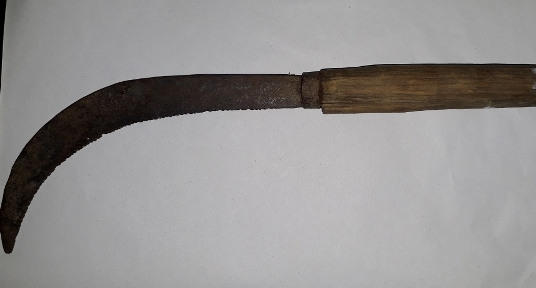
6. Harvesting, Threshing and Winnowing-The cutting and collecting of crop plants after maturity is called harvesting. Harvesting is done by sickle or harvester. Then, threshing is done.                  

Fig.Sickle

The process of separating ripen grain seeds from cut crop plants is called threshing. Threshing is done by thresher machine and combine machine. Combine machine has combination properties of harvester and thresher. Then, winnowing is done.
                                     
The process of separating grains from chaffs by the help of wind is called weeding. The grains mixed with chaffs are dropped from a certain height and blowing wind carries away the lighter chaffs leaving heavy grains at one place.
       7. Storage of grains- After harvesting, threshing and winnowing there comes the last step of storage of grains. The fresh grains (seeds) contain moisture. If they are stored immediately they will be spoiled, attacked by bacteria, fungi, insects, pests and lose their germination capacity.The storage place should be clean, dry, ventilated, made free from germs and no entry point should be left for entry of rodents and pests. The seed grain should be dried in the sunlight to reduce the moisture content. Then, the grains are stored in two common methods-
          (a) Dry storage - Grains are packed in jute bags, plastic or metallic drums. Margosa (Neem) leaves are used to repel the insects. So, they are kept inside the grains. Silos, granaries and godowns are used for large storage of grains. Certain chemicals or fumigation (pests like insects, rat etc. repelling smoke) is used to protect the grains in silos, granaries and godowns.
          (b) Cold Storage – Those agricultural products which spoil easily because of less life should be stored at low temperature in cold stores. At low temperature the enzymes of microbes become inactive; therefore, the grains remain safe there.

          ANIMAL HUSBANDRY- We get our food from plants as well as from animals. We get milk, eggs, meat, and honey as food from animals. The rearing, proving proper food, shelter and taking care of domestic animals is called animal husbandry. Milk giving animals are called ‘milch’ animals. E.g.- Cow, Buffalo, Goat etc. Animals used in different works are called ‘drought’ animals. e.g.- Donkey, Ox, Camel, Yak etc.  We also get wool, leather, pearl, horn and bones from animals.
              CHEK YOUR PROGRESS 1-
Q1. Define crop. What are the types of crops?
Q.2. Write three difference between the types of crops.
Q.3. How soil is prepared before seed sowing?
Q.4. Write an experiment to segregate good seeds from infected seeds before seed sowing.
Q.5. Differentiate between Manures and fertilizers.
CHEK YOUR PROGRESS 2 -
               Q.1. What are weeds? Why they harm the crops if grows along crops?
Q.2. What are weedicides? Write an example of weedicide.
Q.3. Define irrigation. What are the traditional methods of irrigation?
Q.4.What are the modern methods of irrigation? Explain with suitable diagrams.
Q.5 Explain the terms- harvesting, threshing, and winnowing.
Q.6 What should be done before storage of grains?
Project- Prepare a project on various kinds of revolutions took place to increase productivity in agriculture and allied sectors.
Hint / Key words- Need of increasing productivity, census data, Norman S Borlaug, Dr. M.S. Swaminathan, Green Revolution, Yellow revolution, white revolution and Blue revolution, Charts showing increased productivity.
                                            EXERCISE QUESTIONS- SOLVED
Q.1 Select the correct word from the following list and fill the blanks.
           float, water, crop, nutrients, preparation
(a)    The same kind of plants grown and cultivated on a large scale at a place is called…………………
(b)   The first step before growing crops is………………………. of the soil.
(c)    Damaged seeds would …………………. on top of water.
(d)   For growing a crop, sufficient sunlight and………………..and………………….from the soil are essential.
Answer- (a) crop     (b) Preparation    (c) float   (d) water, nutrients

Q.2 Match items in column A with those in column B.
                 Column A                                   Column B
(i)        Kharif Crops                     (a) Food for cattle
(ii)      Rabi crops                         (b) Urea and superphosphate
(iii)     Chemical fertilizers          (c) Animal excreta, cow dung, urine and plant 
                                                   Waste
(iv)      Organic manure                (d) Wheat, gram and pea
                                                     (e) Paddy and maize
                     Answer- (i) –e    (ii)-d   (iii)-b   (iv)-c

Q.3 Give two example of each.
(a) Kharif crop
(b) Rabi Crop  
Answer- (a) Kharif crop – Paddy and maize   (b) Rabi Crop –Wheat and barley
Q.4 Write a paragraph in your own words on each of the following:
(a) Preparation of soil                                       (b) Sowing
(c) Weeding                                                        (d) Threshing
Answer-
(a)    Preparation of soil -The turning and loosening of soil is first basic activity for cultivation of crops. The loosen soil allows the growth of roots more deep. The air get entrapped in loosen soil, which is taken by the roots of plants. So, better aeration of soil occurs. Manures and fertilizers can mix uniformly with the soil. The plants can absorb more mineral salts. The growth of useful bacteria and earthworms is better in this soil. The nutrients present in dead plants and animals are released back into the soil by microbes. The unwanted plants (weeds) are uprooted due to ploughing. The process of loosening and turning of soil is called ploughing or tilling. Ploughing can be done by plough, hoe or cultivator.
      The ploughed fields may have big pieces of soil called ‘crumbs’. By levelling with the help of a leveller the top soil of crop field is made uniform. Leveller is a wooden plank driven by oxen or tractor. Due to levelling- surface of crop field becomes uniform, uniform distribution of water during irrigation, preventing loss of top fertile soil, and ease in seed sowing occurs.
      (b) Sowing- The process of placing of seeds during correct time, space and  depth is called seed sowing. The seeds can be sown by manual dispersal called seed broadcasting or by seed drills. Manual seed dispersal has certain disadvantages like-
    (i) Unequal distribution in the field, somewhere very scanty and somewhere overcrowding of seeds occurs.
                       (ii) The seeds on the surface take more time to germinate and may likely to be    
        eaten by birds. But, seed drills save time put the seeds at proper depth, and space. The appropriate distance among plants allows them to have sufficient sunlight, water and nutrients from soil. So, the crop production is also good.
(c) Weeding-The unwanted plants growing in the crop field are called weeds. Weeds compete with crop plants for water, nutrients, space and sunlight. So, they affect the growth of the crops. e.g.- Grasses, Amaranthus (Chaulai), Chenopodium (Bathua), Parthenium, Wild Oat etc. The process of removal of weeds is called weeding. The weeds can be removed manually by handpicking, using trowel (Khurpi), spade or harrow like agricultural devices. Weeds can also be killed by weedicide like 2, 4-D (2, 4 Dichlorophenopsy acetic acid).The process of killing or removing of weeds is called weeding.
(d)   Threshing- The process of separating ripen grain seeds from cut crop plants is called threshing. Threshing is done by thresher machine and combine machine.
Q.5 Explain how fertilizers are different from manure.
Ans- Differences between manure and fertilizers-:-
               
S.N.
MANURES
FERTILIZERS
1
Manures are organic (natural) substances.
They are inorganic substances.
2
They improve soil texture by adding humus.
They do not improve soil texture.
3
They are prepared in fields or pits.
They are prepared in factories.
4

They are bulky and difficult to carry and
handle.
They are relatively comfortable to carry and handle.
5
They are absorbed slowly by plants.
They are absorbed easily by plants.
6

e.g-Compost, Green manures, Farmyard
manures etc.
e.g.- Urea, NPK, Ammonium sulphate etc.
Q.6 What is irrigation? Describe two methods of irrigation which conserve water.
Ans- The process of supplying water to crop plants at regular interval of time is called irrigation. The two modern methods of irrigation that saves water are – Drip irrigation and Sprinkler System.
Drip Irrigation- In it water is supplied to crop plants drop by drop through pipes near the base of plants.  
                                     
 Sprinkler System- It is a network of pipes in which water is supplied and few pipes have rotating nozzles on the top that sprinkle the water all around. 
                                     
 Q.7 If wheat is sown in the Kharif season, what would happen?
Ans- Wheat is a rabi crop. It does not require more water and sunlight duration. During Kharif season the rainfall is heavy as well as sunlight duration is long. So, wheat crop will be destroyed easily in Kharif season.
Q.8 Explain how soil gets affected by the continuous plantation of crops in a field.
Ans- Due to continuous growing of crops year after year in the same field, there is lack of nutrients in the soil. So, adding of nutrients become imperative for the healthy growth of crops and increasing crop productivity. Manures and chemical fertilizers provide nutrients to the plants for their healthy growth. Field fallow, crop rotation, and mixed cropping are also useful.
Q.9 What are weeds? How can we control them?
Ans- The unwanted plants growing in the crop field are called weeds. Weeds compete with crop plants for water, nutrients, space and sunlight. So, they affect the growth of the crops. e.g.- Grasses, Amaranthus (Chaulai), Chenopodium (Bathua), Parthenium, Wild Oat etc. The process of removal of weeds is called weeding. The weeds can be removed manually by handpicking, using trowel (Khurpi), spade or harrow like agricultural devices. Weeds can also be killed by weedicide like 2, 4-D (2, 4 Dichlorophenopsy acetic acid).The process of killing or removing of weeds is called weeding. Spraying of weedicide is manually done by sprayer machine.
Q.10 Arrange the following boxes in proper order to make a flow chart of sugarcane crop production.

1.Sending crop to sugar factory

4.Sowing

2.Irrigation

3.Harvesting
   

7.Manuring

6. Ploughing the field

5.Preparation of soil


   Answer- Ploughing the field -->Preparation of soil--> Manuring --> Sowing-->Irrigation --> Harvesting --> Sending crop to sugar factory